Carfest
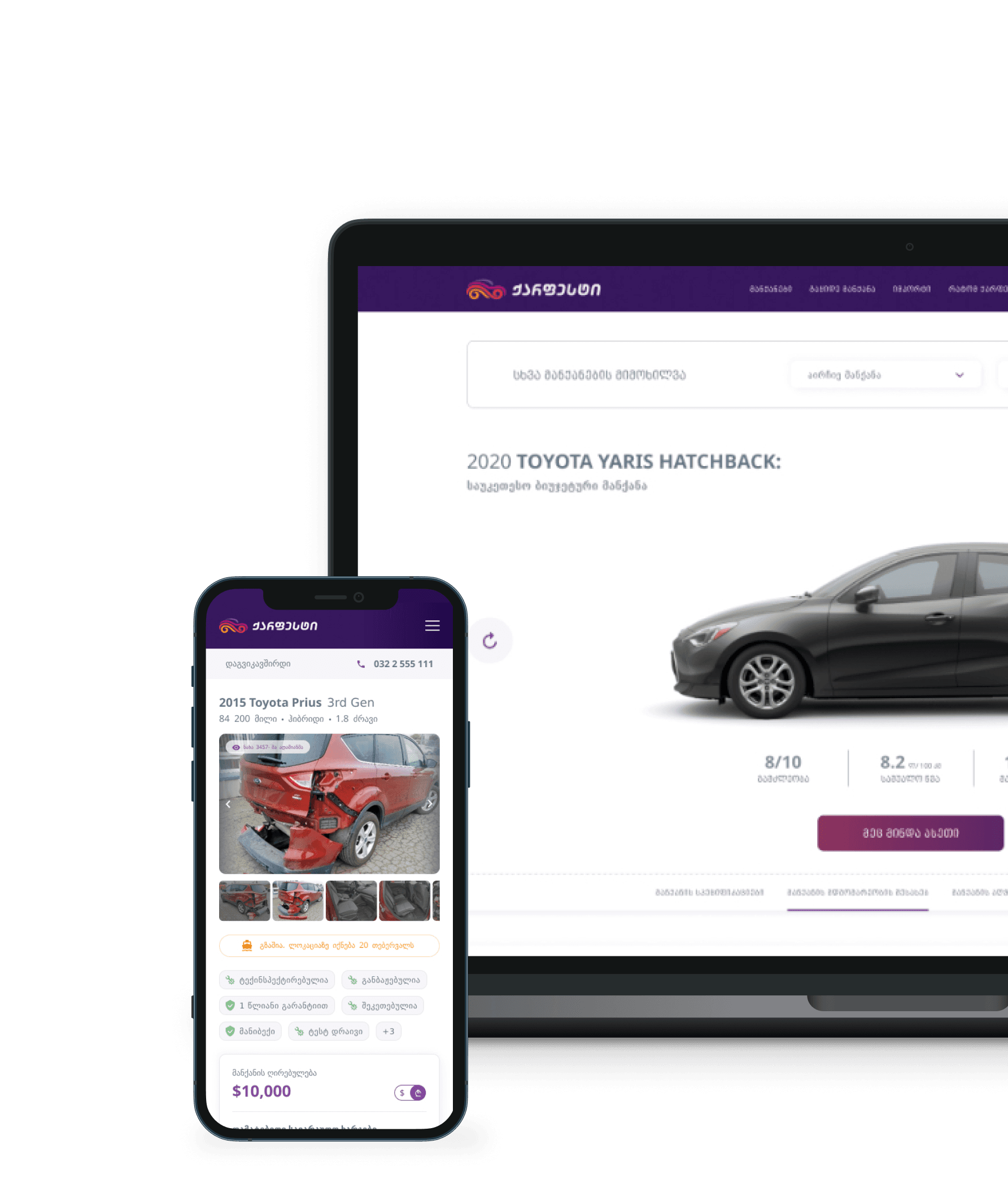

Carfest was Georgia's first digital car dealership. It sold used cars, including cars bought at US auctions, and every car came with a 150+ point condition report, a 1-year warranty on the engine, gearbox and axle, and a 7-day money-back guarantee. Buyers could browse cars already in Tbilisi, cars still on their way, and cars coming up for auction; see what each one would cost once repaired and cleared through customs; and apply for leasing from the car page itself.
Redberry designed and built Carfest from the ground up, starting in 2019, as a dedicated agile team covering user research, product and brand design, engineering, DevOps, and growth strategy. The business grew from zero to a $10 million run rate within its first year, and by January 2022, Carfest reported selling 100 to 150 cars a month. Everything ran on one Laravel application: the storefront, the operations back office on Laravel Nova and the scheduled jobs that kept prices, arrivals and financing offers current.
We are responsible for

Challenge
Buying a used car in Georgia was a frustrating and time-consuming process. Buyers brought technicians to viewing after viewing to check a car's condition, struggled to trace its history, and still could not be sure of its overall state. The automotive market was fragmented, with no central control over vehicle condition.
Carfest set out to sell what the market didn't offer: a used car with a warranty. Promising a 1-year warranty on the engine, gearbox and axle meant every car had to meet a standard Carfest was willing to guarantee, and buyers needed a reason to believe that promise before they visited. Selling online added a harder layer. A single car could be at auction, in transit or in Tbilisi; repaired or not; cleared through customs or not; and each state changed what it cost, how it could be financed and what a buyer needed to know before committing. With the business growing from its first car to a multi-million-dollar run rate within a year, every inquiry also needed to reach the sales team without delay.
Solution
Redberry built Carfest as a Laravel-native commerce platform organized around the car's journey from auction to driveway. Each car was a single record that held its full cost structure - auction or invoice price, transportation, customs and repair - together with its stage: listed at auction, in transit, arrived, damaged or repaired. Listings, filters, the car page, financing offers and the marketing feeds all read from that one model, so a car's price and status matched wherever it appeared.
Around that core, the platform connected Carfest to the partners the dealership depended on: leasing companies, a lender, the US auctions and the sales team's CRM. Financing offers, live bids and every buyer inquiry flowed through the same system that held the inventory, and scheduled jobs kept prices, arrivals and financing current without manual updates. Carfest's team ran inventory, inspections, auctions and campaign pages from a back office built on Laravel Nova.




Import and Customs Calculators
For buyers who wanted a specific car that was not in stock, Carfest offered an import service backed by two calculators. The first returned the landed price at Poti for a chosen make, model and year. Prices came from a spreadsheet filled in by hand: a console command loaded it, cleaned the hand-typed entries, expanded year ranges into year-by-year prices and cached the result, so prices were updated in the sheet rather than in code. The second estimated customs clearance in lari from engine volume, year, steering side and fuel type: it applied an excise rate set by steering side and fuel, scaled it by engine size and an age coefficient, then added import duty and fixed processing fees. The landed-price calculator ended with a request to speak to an import manager, which arrived in the CRM already tagged as an import lead.


Leasing Comparison and Instant Financing
Carfest showed financing on every listing. A separate leasing-calculator service, connected through a Laravel package Redberry wrote, held the partners' conditions. Carfest published its inventory to that service every day and pulled back the lowest 60-month payment for each car, which the listing showed alongside the price. The leasing calculator let a buyer set the car price, down payment, term (12 to 60 months), and credit standing, then compare partner offers, including those their credit profile did not qualify for and why. When a buyer applied with their personal ID and consent, the platform requested their conditions from a lending partner's API and showed an approval result on the spot.


Trade-In, Model Reviews, and Car Requests
Carfest brought in buyers who were not ready to pick from the current stock. A trade-in flow recorded the make, model, year and mileage of a buyer's current car, saved it, and sent it to sales flagged for a trade-in, so the buyer could exchange it for a Carfest car under warranty. A sell-your-car flow collected the same details for sellers, and the final offer followed Carfest's assessment of the car. Carfest Space, the review section, published model reviews with durability, fuel consumption and top-speed ratings; a used-price range; pros and cons; specifications; photo galleries; and testimonials. Each review included a request for the same model, which reached the CRM linked to the review the buyer came from.


Applications, Accounts, and Lead Capture
Every car page led to an application. The form let a buyer choose between leasing and a staged payment plan, leave their details, or request a consultation for a call instead. Customers registered with their phone number and an SMS code, and their account listed their payments. Every form ended in the CRM, with several queued jobs that carried the car link, payment method and the UTM parameters stored in cookies when the buyer arrived from a campaign, so sales and marketing could trace each lead to its campaign. When a lead changed stage in the CRM, a webhook sent the buyer an SMS from a template the team edited in the back office.

Meet the authors
We are a 200+ people agency and provide product design, software development, and creative growth marketing services to companies ranging from fresh startups to established enterprises. Our work has earned us 100+ international awards, partnerships with Laravel, Vue, Meta, and Google, and the title of Georgia’s agency of the year in 2019 and 2021.



e-Mobility

Food Delivery Mobile App & Platform