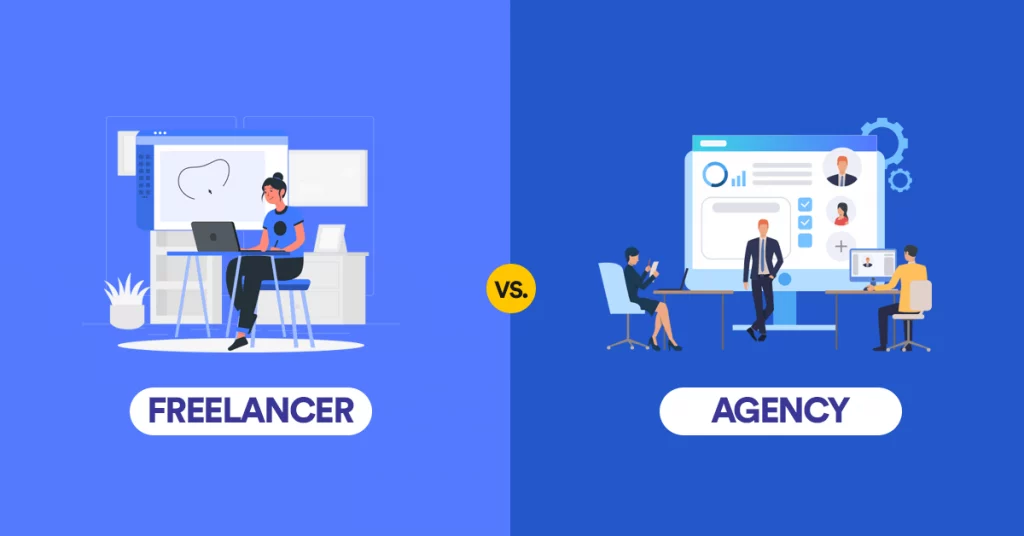
When developing a digital product, companies are faced with a dilemma: should they hire a freelancer vs. agency to get the job done? Both options can be effective, but they solve different problems.
Freelancers often provide flexibility and lower upfront costs, while agencies bring broader expertise, established processes, and greater scalability.
The right choice depends on your goals, budget, timeline, and the complexity of the project. In this guide, we'll look at where each model performs best and what factors should influence your decision.
Why Freelancers Might Work Sometimes

Cost-effectiveness
One reason why companies tend to choose freelancers is that sometimes hiring a freelancer is can be a more cost-effective option than hiring a digital agency. Freelancers typically have lower overhead costs and charge less. Additionally, they often do not share their earnings with others and do not pay taxes, so you pay only for the specific project completed.
However, when it comes to pricing, while freelancers can offer lower hourly rates, outsourcing to an agency in regions like Eastern Europe can offer similar arbitrage in service prices while providing a wide range of benefits as a bonus.
Flexibility
Flexibility is another factor why some companies might choose freelancer vs. agency. This is mainly because freelancers are usually willing to adjust their working hours to meet the company's needs. Besides, they have more freedom in terms of where and when they work, as they are not restricted to a specific office or schedule.
On top of that, if a tech-savvy person is looking for a team member, they usually prefer to work directly with a developer without middle management, since direct collaboration allows for a more streamlined and efficient collaboration.
However, it's important to note some software agencies have recognized the appeal of direct collaboration and have adapted their engagement models to offer similar experiences to working with a freelancer. These agencies allow clients to work directly with developers or designers, bypassing middle management and streamlining the project process.
Making the Smart Move: Why a Software Development Agency is the Answer
With their expertise and cutting-edge solutions, a software agency can help bring your vision to life and take your business to new heights. So without further ado, let’s unleash the factors why choosing a reliable and reputable agency can be a wise decision for your software development needs.
Expertise
When it comes to software development, expertise makes all the difference in the success of a project. A software agency comprises a team of developers with diverse skills and areas of expertise, ensuring that your project has access to a vast pool of talent and knowledge. This not only helps to ensure that your project is completed efficiently and effectively, but it also means that you have access to the best possible solutions for your specific needs.
Plus, when it comes to software development agencies, the biggest difference usually isn't coding ability. It's how teams make decisions. Experienced agencies often have architects, senior engineers, and delivery leads who help ensure that technical decisions support long-term business goals.
So by choosing an agency, you can rest assured that your project will be in the hands of a team of experts with the knowledge and experience necessary to bring your vision to life.
Delivery Process and Quality Assurance

Successful software projects depend on much more than technical expertise. They require a structured delivery process that keeps teams aligned, reduces risk, and ensures quality from the earliest planning stages to post-launch support.
This is often where agencies have an advantage. While freelancers are typically responsible for managing every aspect of a project themselves, agencies usually operate with established processes designed to keep projects moving efficiently and predictably.
For example, at Redberry, every project begins with a discovery phase, where we work closely with clients to define business objectives, validate requirements, identify potential risks, and establish a clear roadmap before development starts. This helps ensure that the team is solving the right problem before writing the first line of code.
Development itself is then delivered through structured iterations, allowing stakeholders to review progress regularly, provide feedback, and adjust priorities as the product evolves. This approach reduces uncertainty and helps avoid costly rework later in the project.
Quality assurance is integrated throughout the entire delivery cycle rather than being treated as a final checkpoint. Code reviews, testing procedures, documentation, and continuous communication all contribute to maintaining quality and long-term maintainability.
In our experience, projects rarely fail because developers lack technical skills. More often, challenges arise from unclear requirements, misaligned expectations, or a lack of process. A structured delivery framework helps prevent these issues and creates a more predictable path from idea to launch.
Communication
Communication is a critical component of a successful collaboration. When working with a software development agency, you can count on having dedicated project/account managers who are committed to ensuring effective communication between the development team and your company. They act as a mediator between the two parties, ensuring everyone is on the same page and that any questions or concerns are quickly addressed.
They also provide regular updates on the project's progress, ensuring that you are always in the loop and aware of any potential obstacles or delays. This level of communication helps to keep the project on track and reduces the likelihood of any misunderstandings or miscommunications that could slow down the project.
Trustworthiness
We mentioned that choosing a reliable and reputable agency can be a great choice for your product. And the keywords here are reliable and reputable. It usually takes years and a few dozen successful projects for an agency to build up its reputation and trustworthiness within a certain market. And when they take on new projects, there’s always the added pressure of upholding the reputation on which their business basically relies. In short, it is imperative for agencies to prioritize client satisfaction to maintain their credibility and trustworthiness.
Therefore, the level of accountability and responsibility is always pretty high when working with a reputable agency. And if there are any issues with the work produced, the agency will be more likely to go the extra mile to resolve them and ensure that your project is a success. This level of accountability provides a level of reassurance and peace of mind that is difficult to find when working with freelancers.
While freelancers face pressure to maintain a positive rating, relying solely on these evaluations may not be sufficient. Unlike agencies, there is no authoritative platform that verifies and rigorously checks freelancers' reviews, making it harder to trust their credibility.
The greatest examples of these types of trustworthy third-party platforms include Clutch and Goodfirms. This not only serves as a guarantee that your investment will be worthwhile, but it also provides a good insight into the agency's strengths and weaknesses, allowing you to determine whether they have the skills and expertise to deliver a project according to your business needs.
Can They Support AI and Automation Initiatives?
The way software is built is changing rapidly. Today, many products go beyond traditional web development and incorporate AI-powered features, automation workflows, and data-driven decision-making. As a result, it's worth considering whether your development partner can support these initiatives, not just today, but as your product evolves.
This doesn't necessarily mean your project needs AI from day one. However, choosing a team that understands modern technologies can make future enhancements much easier. Whether it's automating internal processes, building intelligent workflows, integrating AI models, or connecting multiple systems together, these capabilities are becoming increasingly valuable across industries.
In our experience, successful AI initiatives rarely depend on AI alone. They require strong backend architecture, thoughtful user experiences, reliable integrations, and scalable infrastructure working together. That's why teams with expertise across multiple disciplines are often better equipped to turn AI ideas into practical business solutions.
For example, many of the solutions we build through our AI Agent Development services combine AI capabilities with existing business systems, workflows, and operational processes rather than treating AI as a standalone feature. This approach helps ensure that automation delivers measurable value instead of unnecessary complexity.
If innovation, automation, or AI-powered workflows are part of your long-term vision, make sure your development partner has experience beyond traditional application development. The ability to combine software engineering with emerging technologies can become a significant advantage as your product grows.
The Bottom Line
There’s no universal answer to the freelancer-versus-agency debate. Both models have their strengths, and the right choice depends on your project’s complexity, budget, timeline, and long-term goals.
To make the decision easier, here’s a side-by-side comparison of the key factors that typically influence the outcome of a software development project.
| Factor | Freelancer | Agency |
|---|---|---|
| Upfront Cost | Lower | Higher |
| Expertise Coverage | Limited to one person | Multiple specialists |
| Scalability | Limited | High |
| Project Management | Usually self-managed | Structured process |
| Continuity | Depends on availability | Shared responsibility |
| Best For | Small projects, MVPs | Complex or growing products |
Frequently Asked Questions
Is it cheaper to hire a freelancer or an agency?
Usually, freelancers have lower upfront rates, but agencies can be more cost-efficient for larger or longer-term projects due to their processes and broader expertise.
What Is The Difference Between the Freelancer vs. Agency model?
A freelancer is an individual who works independently and offers their services to clients on a project-by-project basis. They are usually self-employed and work on a flexible schedule. On the other hand, an agency is a company that provides software development services to clients. Agencies typically have a team of professionals working together to deliver projects, including developers, designers, and project managers.
Can agencies provide dedicated developers?
Yes. Many agencies now offer embedded team models that allow clients to work directly with dedicated developers while still benefiting from agency support.
Can freelancers build enterprise applications?
Yes, but enterprise projects often benefit from additional expertise in architecture, DevOps, QA, and project management.
Written by Keti Getiashvili