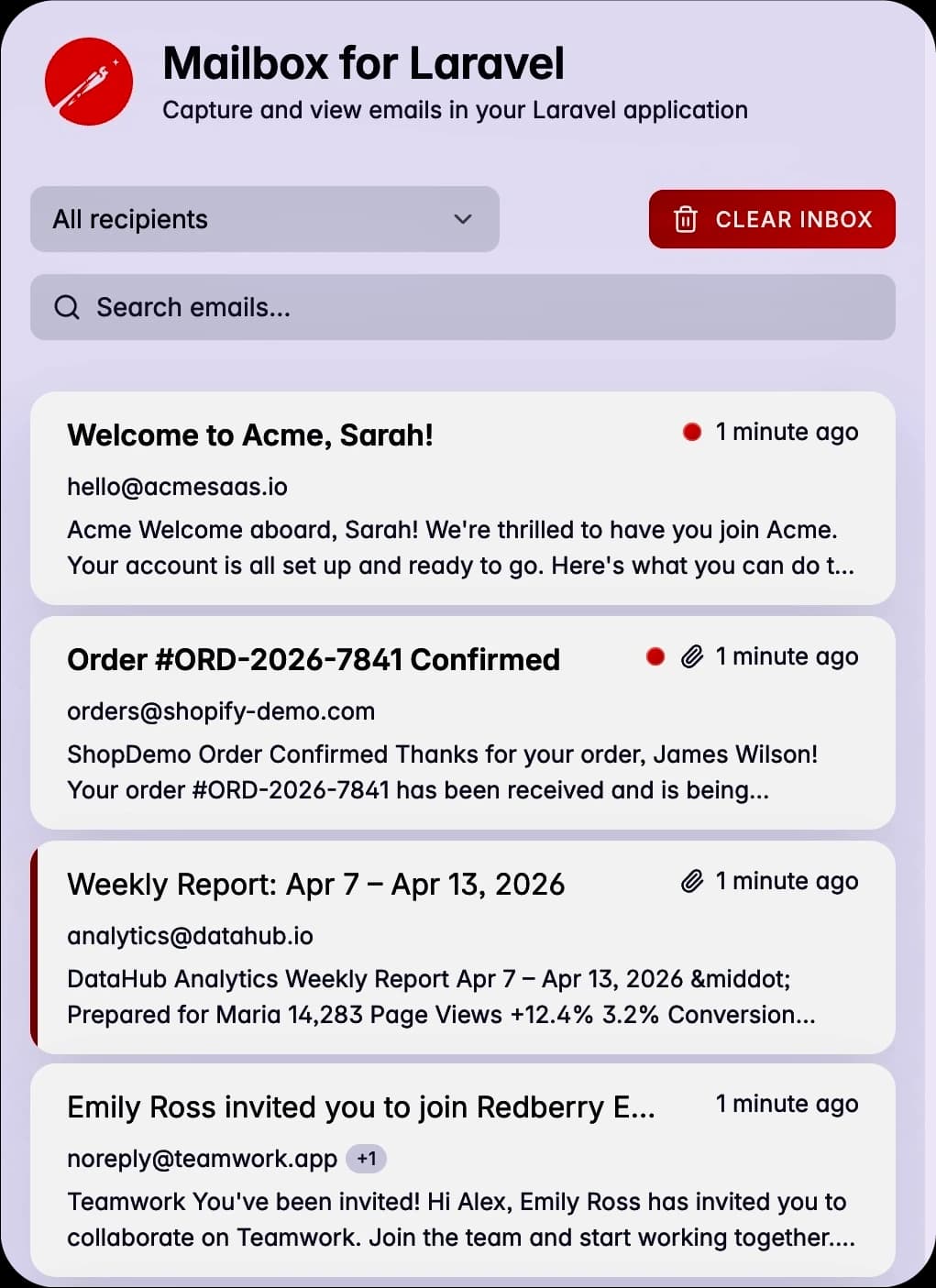
A zero-configuration local email inbox for your Laravel app. Capture, inspect, and debug every outgoing email - no external services required.
.webp&w=1920&q=75&dpl=dpl_BRe7iXcVH4XjhJwZSen2jWtGWenx)
You’re building email flows - welcome emails, password resets, invoices, notifications - but testing them is painful.
You get a wall of headers and encoded HTML in your log file. No way to see what the user actually receives.
External services add friction
Mailtrap, Mailhog, and similar tools require accounts, API keys, Docker containers, or running separate processes. Every team member has to set them up.
Emails break silently
A broken layout, a missing variable, a wrong recipient — you don’t catch it until someone reports it or you dig through logs.
Onboarding is slow
New developers on the project need to configure an email testing tool before they can work on anything that sends mail.

Like Mailtrap - but it lives inside your app. No signups. No API keys. No extra processes. One composer require and you’re done.
1
You’re iterating on a transactional email. Instead of sending it to a real address, checking Mailtrap, or reading log files - just open "/mailbox" in your browser. Every email your app sends is right there, rendered exactly as the recipient would see it.
2
Everyone on the team gets the same email debugging experience out of the box. No shared Mailtrap accounts, no “did you configure your mail driver?” questions. It’s in the repo. It just works.
3
Mailbox captures emails silently without sending them to real recipients. Use it in staging to verify email flows without accidentally emailing customers. Auto-enabled in non-production environments.
Mailbox intercepts all outgoing emails and displays them in a beautiful, self-contained dashboard.
Set MAIL_MAILER=mailbox and you’re done. No API keys, no external accounts, no setup.
View, download, and preview email attachments including inline images.
Every email your application sends is intercepted and stored locally for inspection.
A full-featured email client UI built with Vue 3 and Tailwind, served at /mailbox.
Choose between database (SQLite, MySQL, PostgreSQL) or JSON file storage.
A polished dark theme that matches your development environment.
Set MAIL_MAILER=mailbox and you’re done. No API keys, no external accounts, no setup.
View, download, and preview email attachments including inline images.
Every email your application sends is intercepted and stored locally for inspection.
A full-featured email client UI built with Vue 3 and Tailwind, served at /mailbox.
Three steps. No accounts. No configuration files. No environment variables beyond the mailer.
Add Mailbox to your Laravel project and install everything it needs.
Point Laravel’s mailer to Mailbox with a single environment variable.
Every email is captured and displayed at /mailbox.

Browse all captured emails with subject, sender, recipients, and timestamps.
Switch between HTML preview, plain text, and raw RFC 822 source.
View and download attachments directly from the dashboard.
Delete individual messages or clear the entire inbox
Paginated, searchable, and responsive
Database
Default. Uses a dedicated SQLite connection out of the box. Supports MySQL and PostgreSQL.
File
JSON files in storage/app/mailbox/. No database required.
Custom
Implement the MessageStore contract for Redis, S3, or any backend you need.
Sensible defaults. Full control when you need it.
Storage driver-database, file, or a custom implementation.
Retention period -How long to keep captured emails (default: 24 hours)
Polling interval-Real-time update frequency in milliseconds
Attachment limits-Max file size, total size, and allowed MIME types
Authorization gate-Custom gate for dashboard access control
Route prefix -Change the dashboard URL from /mailbox to anything
Auto-enabled only in non-production environments
Gate-based authorization via Laravel’s Gate facade
Configurable redirect for unauthorized users
Middleware stack is fully customizable
MIME type whitelist prevents unsafe file storage
Install Mailbox and see every email your Laravel app sends



.webp&w=1024&q=75&dpl=dpl_BRe7iXcVH4XjhJwZSen2jWtGWenx)